Work from Home Archives - Must Have Solutions

Archive

Category Archives for "Work from Home"

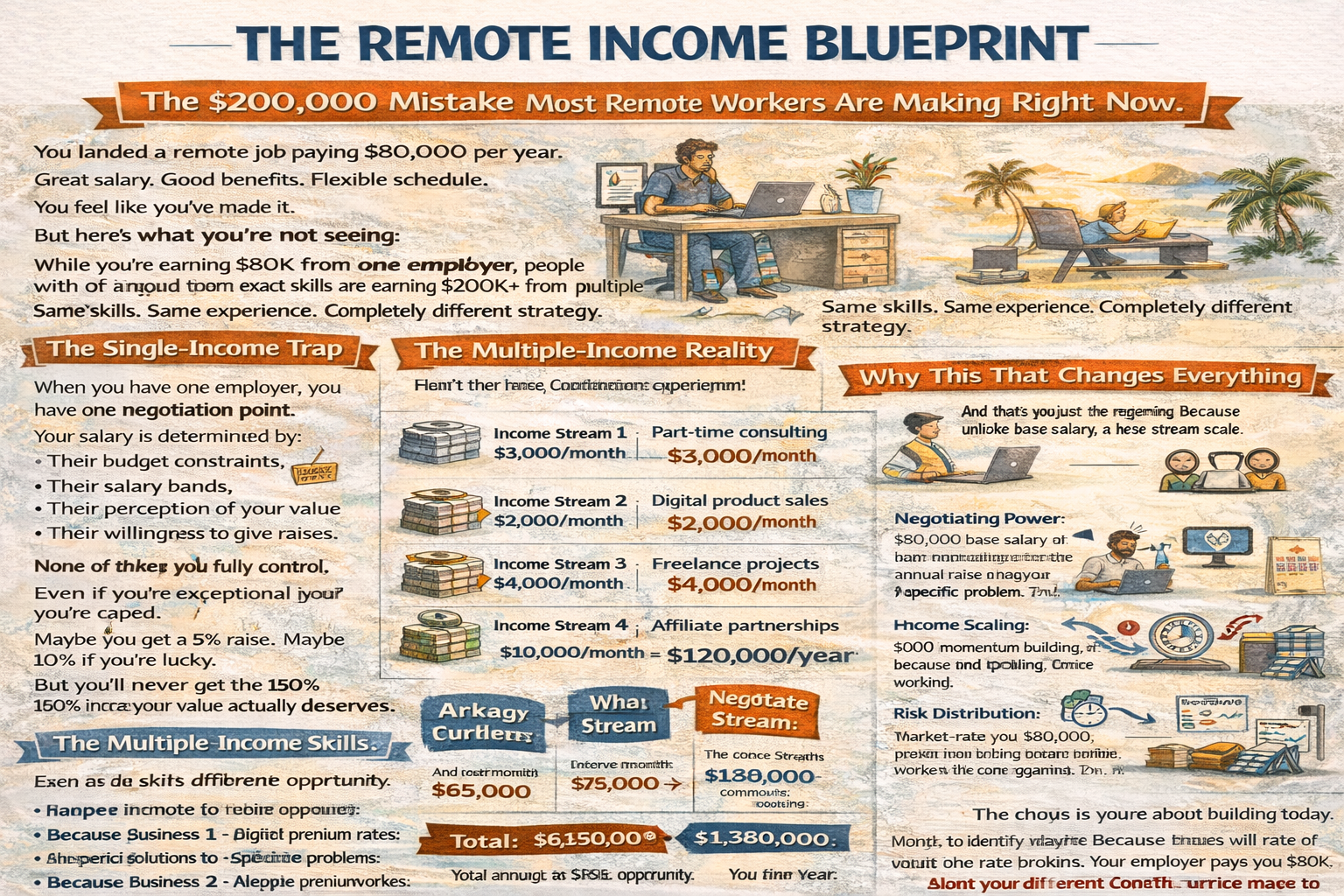
The $200,000 Mistake Most Remote Workers Are Making Right Now

The $200,000 Mistake Most Remote Workers Are Making Right Now

You landed a remote job paying $80,000 per year.

Great salary. Good benefits. Flexible schedule.

You feel like you've made it.

But here's what you're not seeing:

While you're earning $80K from one employer, people with your exact same skills are earning $200K+ from multiple income sources.

Same skills. Same experience. Completely different strategy.

The Single-Income Trap

When you have one employer, you have one negotiation point.

Your salary is determined by:

  • Their budget constraints
  • Their salary bands
  • Their perception of your value
  • Their willingness to give raises

None of which you fully control.

Even if you're exceptional at your job, you're capped.

Maybe you get a 5% raise. Maybe 10% if you're lucky.

But you'll never get the 150% increase your value actually deserves.

The Multiple-Income Reality

Now consider a different approach:

Income Stream 1: Part-time consulting - $3,000/month

Income Stream 2: Digital product sales - $2,000/month

Income Stream 3: Freelance projects - $4,000/month

Income Stream 4: Affiliate partnerships - $1,000/month

Total: $10,000/month = $120,000/year

And that's just the beginning.

Because unlike a salary, these streams can scale.

Why This Works

Multiple income streams give you something a job never can:

Negotiating Power

When one client lowballs you, you can walk away. You have other income.

Income Scaling

Your earning potential isn't capped by someone else's budget.

Risk Distribution

Lose one client? You still have three others paying you.

Market-Rate Pricing

You charge what you're actually worth, not what HR budgeted.

The Math That Changes Everything

Let's break down the real cost of single-income dependency:

Scenario A: Remote Employee

  • Base salary: $80,000
  • Annual raise: 5% = $4,000
  • 10-year earnings: ~$1,005,000

Scenario B: Multiple Income Streams

  • Year 1: $60,000 (building phase)
  • Year 2: $90,000 (momentum building)
  • Year 3: $120,000 (systems working)
  • Year 4-10: $150,000+ (compounding)
  • 10-year earnings: ~$1,380,000

Difference: $375,000

That's the cost of staying in single-income mode.

The Skill Arbitrage Opportunity

Here's what most people miss:

The skills you use in your remote job are worth MORE on the open market.

Why?

Because businesses will pay premium rates for specific solutions to specific problems.

Your employer pays you $80K to handle 20 different responsibilities.

But clients will pay $5,000 for you to solve ONE specific problem.

Same skills. Different packaging. 10x the rate.

The Transition Strategy

You don't quit your job tomorrow.

You build strategically:

Months 1-3: Identify Your Marketable Skills

What do you do in your job that businesses pay for?

Project management? Content creation? Data analysis?

Months 4-6: Test the Market

Take on one small freelance project. Prove you can get paid outside your job.

Months 7-9: Build Systems

Create templates. Document processes. Make it repeatable.

Months 10-12: Scale and Diversify

Add income stream #2. Then #3. Build redundancy.

When your side income hits 50% of your job income, you have real options.

Your Reality Check

Right now, answer honestly:

If you lost your job tomorrow, how long until you're earning again?

If your employer cut your salary 20%, could you walk away?

If a better opportunity required a pay cut initially, could you take it?

If the answer is "no" to any of these, you're too dependent.

Your Next Step

Stop celebrating your remote job like it's the finish line.

It's the starting line.

The real question is:

What income streams are you building right now?

What skills are you packaging for the open market?

What's your plan for income independence?

One year from now, you'll either:

Still be 100% dependent on one employer's decision to keep paying you.

Or you'll have multiple income streams and real financial security.

The choice is yours. Start building today.

Ready to build multiple income streams and real independence? Get the complete Remote Income Blueprint with step-by-step strategies.

Start your income transformation here

Why Remote Jobs Aren’t Actually Freedom (And What Is)

Insert Image

Why Remote Jobs Aren't Actually Freedom (And What Is)

You finally got the remote job you wanted.

No more commute. No more office politics. No more pretending to look busy.

You thought this was freedom.

Then reality hit.

You're still trading hours for dollars. Still answering to someone else's schedule. Still one layoff away from financial disaster.

The location changed. The fundamental problem didn't.

Here's what nobody tells you about remote work.

The Remote Job Illusion

Remote work feels like progress because it's better than office work.

And it is better. Genuinely.

You save commute time. You have more flexibility. You can work in your pajamas.

But let's be honest about what you still don't have:

Control over your income ceiling.

Your salary is capped. Your raises are limited. Your earning potential is determined by someone else's budget.

Control over your time.

You still have meetings. Still have deadlines. Still need permission to take vacation.

Control over your security.

One restructuring. One budget cut. One new manager who doesn't like you.

And you're back on LinkedIn, updating your resume, hoping someone else will hire you.

That's not freedom. That's just a nicer cage.

The Income Dependency Problem

Here's the uncomfortable truth:

As long as you have one income source, you're vulnerable.

It doesn't matter if that source is an office job or a remote job.

Single point of failure = maximum risk.

And the risk isn't just financial. It's psychological.

When your entire income depends on one employer, you can't take real risks.

You can't speak up when you disagree. You can't turn down projects that drain you. You can't walk away from toxic situations.

Because walking away means zero income.

What Real Freedom Looks Like

Real freedom isn't about WHERE you work.

It's about WHO controls your income.

Real freedom is:

Multiple income streams that don't depend on any single employer.

The ability to lose one client and still pay your bills.

Income that scales beyond your hours worked.

Real freedom is building your own income infrastructure.

Not hoping someone else will give you permission to earn more.

The Three Income Levels

Level 1: Employee

One income source. Maximum vulnerability. Capped earning potential.

Whether remote or office, you're still dependent.

Level 2: Freelancer

Multiple clients. More control. Income tied to hours worked.

Better than Level 1, but you're still trading time for money.

Level 3: Business Owner

Multiple income streams. Scalable systems. Income decoupled from hours.

This is where real freedom lives.

The Transition Path

Most people think they need to quit their job to build alternative income.

Wrong.

You build while you still have job security.

Nights and weekends become your laboratory.

You test business models. Build skills. Create income streams.

Small at first. $100/month. Then $500. Then $1,000.

When your side income matches your job income, you have options.

Real options. Not just "I hope my boss doesn't fire me" options.

Your Next Move

Stop pretending your remote job is the destination.

It's not. It's a stepping stone.

The real question is:

What are you building on nights and weekends?

What income streams are you testing?

What skills are you developing that could generate money outside your job?

Because one year from now, you'll either:

Still be dependent on one employer, hoping they keep you around.

Or you'll have multiple income streams and real options.

The choice is yours. But the clock is ticking.

Ready to build real income independence? Get the complete Remote Income Blueprint with proven strategies for building multiple income streams.

 Start your transition here

Designing a Calming and Stress-Free Workspace

Designing a Calming and Stress-Free Workspace

By designing a calming, stress-free workspace, you’ll be able to concentrate easier when it’s time to get to work. Doing this raises your productivity level and makes it a healthier space for you to be in.

Check your office. If you have clutter there, even just a little bit, you need to either get it out or organize it. Messy spaces cause stress that you file away in the back of your mind, even when you don’t address it.

Place plants in some of the areas of your office space. You can get decorative pots and use colorful flowers if you like. These bring a little bit of nature indoors. Plus, plants clean the air by removing what’s bad - while at the same time, their photosynthesis process creates oxygen.

This also helps with the air purity in your home. The green color of plants is known to be a natural relaxant and can work to lower anxiety and stress. If you’re not someone with a green thumb, be sure to buy plants that don’t require a lot of effort or attention in order to thrive.

The light matters for more than just eye strain. Dark home office spaces tend to affect one’s mood. Focus on the lighting in your office to make it stress-free. When you choose good lighting, it makes it easier for you to be able to work.

While plenty of lighting is best, you want to be able to have soft lights with adjustable levels of brightness. If you have a window in your office, make use of the natural lighting by using sheer curtains when you want the light and shades for when you don’t want as much light.

Make sure you incorporate artwork as part of your office décor. You can hang photos that are meaningful to you or that make you feel happy. Look for positive designs in colors that are known to boost moods...

Click here to read on and below to claim your free copy of this brand new eBook

Keeping the Air Quality Clean in Your Home Office

Keeping the Air Quality Clean in Your Home Office

The type of air quality in your home office can impact your health. It can lead to things like allergies as well as make you more tired throughout the work day. But there are ways that you can keep the air quality clean.

You may have air vents in your office or work space that are in need of a good cleaning. It’s easy for dust and debris to collect inside as well as outside the vent. When that happens, you don’t get proper air circulation.

Plus, dust can cause sinus problems and make allergies worse. Make sure all vents in the room or space are clean and free of any clutter if you have vents in the floor. The filters in your air unit need to be changed on a regular basis.

This should be scheduled on your calendar as a reminder. The filter works to trap dust and debris and once it’s full, it can negatively impact your air quality. Many people think that an expensive air filter that you change every three months is the best kind to use.

But it’s actually healthier and gives you better air quality when you use the cheaper filter and change them more often. For the best air quality, change the filter once a month. If you have a lot of humidity in your home, this can cause a problem with air quality because it can lead to mildew or mold.

Buy a dehumidifier and use it in your office. The more natural that you can allow your office to be, the better. If you can allow natural sunlight in and the brightness doesn’t affect your work, then do that...

Click here to read on and below to claim your free copy of this brand new eBook

Home Office Lighting That Protects You from Eye Strain

Home Office Lighting That Protects You from Eye Strain

While it’s great to have natural light flooding your office so you can work comfortably, that’s not always an option. The sun doesn’t shine every day and, in the winter, when the days are shorter, you don’t get as much natural light.

That’s why you need home office lighting. But you want to get the type that can prevent you from getting eye strain. Close light is good for your time spent working at a computer.

This means that you should get a sturdy desk lamp. There are specific desk lamps that can be purchased that are designed to alleviate common problems with the eyes when working from home.

Look for a desk lamp that doesn’t use blue light. Some of them do. There are many models that use natural light, which can mimic sunlight. These come with options to change the brightness level as the day goes on.

So you can have natural lighting from the time your work day begins until it’s finished. You can get these lamps as fixed based ones, swinging or swivel lamps. If you have to
toggle between computer monitors or swivel from one desk to another work platform, you’re better off getting the swivel kind because you can adjust the direction of the light.

There are also computer monitor lamps that are anti-glare and can prevent blue light, which causes eye strain. These lamps attach to the top of your monitor and can cause a 45 degree angle path of light that doesn’t focus on the screen - which is what you want... 

Click here to read on and below to claim your free copy of this brand new eBook

Computers, Monitors, Keyboards and Mouse Options

Computers, Monitors, Keyboards and Mouse Options

Every tool that you use in your office should be beneficial to your body. If you’re using something that’s causing you pain or isn’t best for your physical needs, then you should get rid of it and replace it with something that does help.

You might not realize it, but the type of computer that you have can make a difference. Computers such as laptops that have large screens are better for you than ones with smaller screens.

That’s because the smaller the screen, the worse it can affect your posture. If you’re straining to work using the computer monitor, then it’s not good for you. Computers that have an all-in-one keyboard that’s too flat can often cause wrist fatigue.

You want to use computers that have a high definition display and offer the option of blocking blue light, which can cause fatigue as well as chronic dry eyes. The type of monitor that you use also matters.

The ones that are curved are made by design to help alleviate eye strain. That’s because the monitor curves like the eye does. These kinds of monitors also have a better refresh rate and quicker response, which can reduce eye strain.

In addition to that, curved monitors boost productivity while helping ease work strain.
Besides eye strain or fatigue, another notable issue with office equipment is that the wrong kinds can cause injuries.

A keyboard is an important office tool and having the right one can help prevent injuries that are caused by repetitive motion. When you use an ergonomic keyboard, this can alleviate the pain associated with carpal tunnel syndrome.

It can also ease the strain that’s caused by overuse of the wrists, such as what happens with frequent typing. Not only that, but the right kind of keyboard can also remove strain from both the neck and shoulders...

Click here to read on and below to claim your free copy of this brand new eBook

Office Furniture That’s Kind to Your Body

Office Furniture That’s Kind to Your Body

Working from home means you probably do a lot of sitting. That’s why having the right chair is one of the most important pieces of office furniture for your body. If you have to move between your computer and filing cabinets that are located nearby, you need to have a good swivel chair.

Having this type of chair can help keep strain off your back as you turn. Many office chairs have an ergonomic design. These types of chairs can do more than keep you from straining your back and developing aches in that region.

Because this kind of chair offers the best core body support, you won’t feel as tired physically - even after the end of a hectic or long day at work. You’ll find that these kinds of chairs aren’t just comfortable to sit in, but they also give you the support that you need.

Look for ones that have well-padded arm rests as well as offer full lower back support.
Desks are important, too. Most people don’t realize that just as there are supportive office chairs, there are also ergonomic desks.

These types of desks help keep your posture aligned, but don’t place tension across the shoulders because you’re not working hunched over. They allow for comfortable positioning of your hands as you type on the keyboard, plus they offer the space that you need for your legs to be comfortable.

While you can use a desk that you need to sit at in order to work, there are also standing ones that are kind to your body. Studies have shown that people who spend too much time sitting while working are more prone to developing health issues...

Click here to read on and below to claim your free copy of this brand new eBook

32 Proven Ways to Make Money Fast

Here's an excerpt of a great article on Entrepreneur.com which I highly recommend you take a look at!

Some day you won't have to worry about rent money and credit card debt. In the meantime, you have to take control of your financial situation.

In a bind? Need some fast cash? We're talking here about small bursts of capital, not millions of dollars -- enough to satisfy your monthly obligations or get that nagging creditor to stop calling you.

None of the 32 strategies listed here to get some money quickly will break the proverbial bank. Some are easier than others, but nearly all require very little to no capital. They are meant to get you through the difficult times.

Related: 2 Ways to Make Money Online This Month

Some of these strategies to make extra money will require you to be in certain locales, while others are location-independent, but it all boils down to being resourceful. We've all found ourselves in a tight spot at one point in our lives or another, but to the person who's committed, anything is possible. 

Much of this has to do with mindset. When you lack money, scarcity thinking sets in. The scarcity mindset is negative and thinks that there's never enough of whatever it is to go around. When you find yourself thinking like that, do everything in your power to move into an abundant mindset. 

Our thoughts are incredibly powerful. We have upwards of 60,000 thoughts per day, many deep within our subconscious mind, much of which are repeated. We have to be stewards of our thoughts. Once you find yourself thinking negatively, you need to jar yourself out of that...

Read on by clicking here

How to Work from Home and Make Money

Book review:

How to Work from Home and Make Money

Like thousands of other people, you probably end up with more month left over than money. No matter how many pennies you pinch or how good you are at “making do,” you’re just not making it.

Or maybe you were doing great financially and then you lost your job. The good news is that you can turn things around. In the book, How to Work from Home and Make Money, you’ll learn how to say goodbye to the struggle and hello to being your own boss.

The book can teach you what you need to do so set up your business. You’ll have the freedom to decide what days you work and what hours you’ll work. You’ll be in control of your own career path.

You’ll discover that you can forget the myths you might have learned about working from home and embrace the reality that by working at home, you can choose the kind of money  you want to make doing whatever it is you choose to do.

You’ll gain flexibility and freedom when you work for yourself and not others. The book begins by explaining to readers the most common lies about working from home. It then goes into the different kinds of online home-based business ideas and teaches the number one key for your business success.

Solve problems for customers or do something that helps them. When you can meet a need, there’s the market for your business. If you’ve like to have your own store, you can do this without it being a brick and mortar one and the book can show you how.

Even if you don’t have a website right now, you can still get started without one. The author presents opportunities in the field of writing and you don’t have to be a writer to get involved in this type of home business.

You can break into Kindle publishing as well as other types of writing. You’ll learn how you can go offline to work from home if that’s what you prefer. You can start a food-based business.

The author also shares the importance of learning about passive income and teaches readers why this is an important step to create recurring income. There are plenty of opportunities that are available to you through things such as earning an income by teaching online courses.

Once you decide to work from home and choose the job that suits your needs, you’ll be able to live the kind of life that you’ve always hoped for. You’ll be able to take off on vacation whenever the urge strikes.

As the book explains, that doesn’t mean that you won’t work hard at your business. You will - especially in the beginning - but you’ll find the tools that you need in the book to help you get started building your business and making money...

Click below to purchase this excellent book (at a ridiculous price right now!)

Capital Needed For Home Business – Chapter 11

Capital Needed For Home Business

Whether it is a small business or a large one, the amount of capital required for any home business will vary. How much money is needed to start a home business does not have a simple answer? The average amount may be as low as a $1000 to as high as millions depending on the investments, the market you're trying to reach and the type of business you want to start.

The more competition you face and the more the demand for your services is what sets the tone for the capital required to run your home business.

How to know how much Capital is required for your Home Business:

If you're beginning, being able to calculate the amount of capital needed will not be an easy task. If you're new at this, taking some time, in the beginning, to do some research will set you off on the right foot. Only a few businesses can excel without research or prior experience; thus, consulting someone with experience beforehand is advisable before you set off trying to start your home business.

Research:

  • Contact people in the same line of work as you intend to be to know what the starting costs and running costs would be of a similar business.
  • Use a cost calculator designed specifically for startups to know what initial amount of money you will be requiring.
  • Get in touch with retired business people who have worked in the same industry as you and can give you knowledge about it.
  • Contact the suppliers you want to pursue to give you insight on retail prices.
  • Hire a business or accounting expert to help you before you start your business.

Read on by claiming your free copy of the eBook!

1 2 3 4
gtag('config', 'AW-1039902674');